

No, Most Philosophers Aren’t Moral Realists
Clarification of poor inferences from a popular study

Moral realism is the view that there are stance-independent moral truths—that is, truths about what is morally good, valuable, obligatory, and so on, that do not depend for their truth on the attitudes of agents or observers. Moral realism strikes me as totally absurd. But quite apart from the plausibility of the view itself, it is—at least in my experience—frequently claimed that most professional philosophers are moral realists.
This claim is usually based on the results of the 2020 PhilPapers survey1. It is commonly believed that approximately 62.07% of philosophers surveyed on the question of metaethics are moral realists. However, the actual statistic is that approximately 62.07% of respondents to that question either accept or lean toward moral realism.

Merely leaning toward a position is importantly different from accepting it. Someone who merely leans toward moral realism is not, strictly speaking, a moral realist. Yet when this statistic is cited, this distinction is rarely made. Instead, those who accept moral realism and those who merely lean toward it are typically lumped together into a single realist category, reinforcing the impression that most philosophers are moral realists. When we isolate those who actually accept moral realism from those who merely lean toward it, we find that only approximately 37.35% of respondents accept the view.
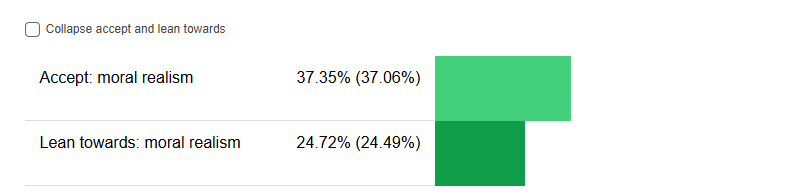
Thus, most philosophers are not moral realists. At best, a sizable minority are, even if most either accept or lean toward the position. But there is reason to doubt even this weaker conclusion.
Interpreting the Question
There is a further issue concerning how respondents interpreted the survey question. In the PhilPapers survey, the candidate answers do not appear to be explicitly defined, but left to respondent interpretation2.
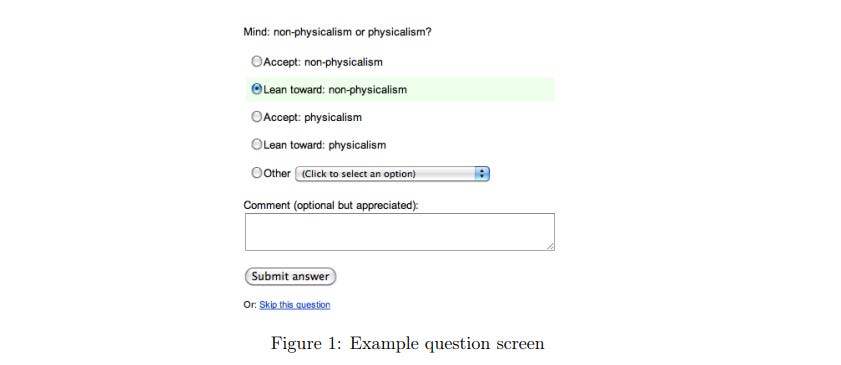
This leaves open the possibility that, for some questions, different philosophers adopted different interpretations of the positions on offer, potentially resulting in misleading results. Since philosophical positions often have relatively standard characterizations, we can ordinarily presume a shared understanding of the questions unless there is reason to doubt this presumption. In the case of moral realism, however, there may be such a reason.
There is evidence that moral realism has not always been commonly understood as the view that there are stance-independent moral truths, this being a relatively recent development. Historically, moral realism was often taken to involve much weaker commitments. According to the Stanford Encyclopedia of Philosophy entry on moral realism3:
Taken at face value, the claim that Nigel has a moral obligation to keep his promise, like the claim that Nyx is a black cat, purports to report a fact and is true if things are as the claim purports. Moral realists are those who think that, in these respects, things should be taken at face value—moral claims do purport to report facts and are true if they get the facts right. Moreover, they hold, at least some moral claims actually are true. That much is the common and more or less defining ground of moral realism (although some accounts of moral realism see it as involving additional commitments, say to the independence of the moral facts from human thought and practice, or to those facts being objective in some specified way).
The author of this entry, Dr. Geoffrey Sayre-McCord, notes that some accounts of moral realism include a requirement of stance-independence, but that this requirement is not part of “the common and more or less defining ground of moral realism.” This does not reflect what appears to be the dominant understanding of moral realism today. Nearly every contemporary presentation of moral realism by prominent figures in the field that I encounter includes a stance-independence requirement. This suggests that there may have been a shift, at some point, in how moral realism is understood by a significant number of contemporary philosophers.
At the outset of this article, I defined moral realism as the view that there are stance-independent moral truths. This appears to be the prevailing usage within the communities most likely to read this article, as well as among many philosophers who engage in public-facing discussions of metaethics, and among the meta-ethicists associated with the view who tend to be the most prominent. It is difficult to establish that this is the common usage simpliciter, given selection effects and related issues. Still, prominent contributors to the discourse such as Michael Huemer4, Eric Sampson5 etc. typically employ the term in this way.
We therefore have two distinct senses of moral realism. Let us call the more recently dominant sense Interpretation One, and the earlier, broader sense Interpretation Two. A range of views count as realist under Interpretation Two but not under Interpretation One—namely, any cognitivist view on which moral judgments are truth-apt, including subjectivism, relativism, and related positions.
The relevant Stanford Encyclopedia of Philosophy entry was first published on October 3, 2005, received a substantive revision on February 3, 2015, and a minor correction in Winter 2023. Thus, the last significant content update dates to 2015. The most recent PhilPapers survey, however, was conducted in 2020. This makes it unclear how many philosophers interpreted the survey question in the intended way. A considerable number—perhaps even a majority—of respondents may have interpreted “moral realism” in accordance with Interpretation Two rather than Interpretation One. On that interpretation, positions now typically classified as anti-realist—such as subjectivism and various forms of relativism—would have counted as realist. Philosophers who held such views, and who would not qualify as realists under Interpretation One, may therefore have identified themselves as realists, or as leaning toward realism, in the survey.
Given this ambiguity, it is unclear how we can be confident that there were no significant differences in how the question was interpreted. Consequently, it is unclear how we can be confident even that most philosophers either accept or lean toward moral realism qua Interpretation One—the sense relevant to the claim that most philosophers are moral realists.
Conclusion
It is frequently claimed that most professional philosophers endorse moral realism. But it is also frequently neglected that the cited figure includes both those who accept the view and those who merely lean toward it, rendering the usual claim misleading. Moreover, we have independent reasons to be skeptical that most philosophers are moral realists in the relevant sense—Interpretation One—given apparent historical shifts in how moral realism has been defined and understood, and the resulting ambiguity and variability in interpretation.
References
Bourget, D., & Chalmers, D. J. (2014). What do philosophers believe? Philosophical Studies, 170(3), 465–500.
Bourget, D., & Chalmers, D. J. (2020). Meta-ethics: moral realism or moral anti-realism? 2020 PhilPapers Survey. PhilPeople.
Huemer, M. (2021). Knowledge, reality, and value: A mostly common sense guide to philosophy. Independently Published.
Sayre-McCord, G. (2023). Moral realism. In E. N. Zalta & U. Nodelman (Eds.), The Stanford Encyclopedia of Philosophy (Winter 2023 Edition). Stanford University.
The Analytic Christian. (2021, February 25). A positive case for objective morality (Dr. Eric Sampson) [Video].
Bourget, D., & Chalmers, D. J. (2020)
Bourget, D., & Chalmers, D. J. (2014)
Sayre-McCord, G. (2023)
Huemer, M. (2021), and in several additional podcast/interview style discussions involving the same philosopher.
The Analytic Christian. (2021, February 25), and in several additional podcast/interview style discussions involving the same philosopher.
As a point of clarification, you say:
"The relevant Stanford Encyclopedia of Philosophy entry was first published on October 3, 2005, received a substantive revision on February 3, 2015, and a minor correction in Winter 2023. Thus, the last significant content update dates to 2015. The most recent PhilPapers survey, however, was conducted in 2020."
I've seen someone criticize the article by interpreting you as making the claim that there's been a dramatic shift the definition of realism philosophers favor in that period of five years. First, I think it could be read this way but I was skeptical you meant to suggest this, so some rewording might help clarify.
Second, note that there was also a 2009 PhilPapers survey where the realism rate was 56.4%:
https://philpapers.org/surveys/results.pl
It is probably worth mentioning and engaging with this as well.
I do think there's been a shift, but I think it's occurred over a few years. Finally, regarding the update of 2015 to the SEP entry: I don't know how these updates are made, but SEP articles typically have only one author, and as a result may reflect the perspective of that author even if their definition is less popular.
Just FYI it's Eric Sampson, not Erik Sampson. Feel free to delete this!